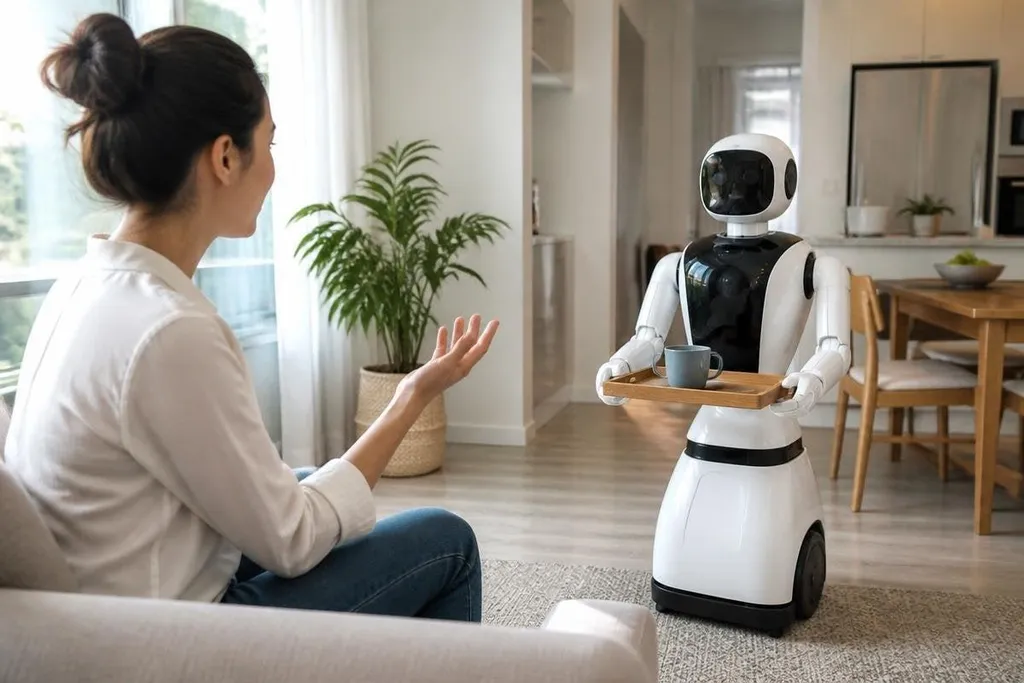
For a social robot, sensing a person, understanding a request, and choosing a safe response are linked tasks. AI changes each part through speech recognition, computer vision, and software that can work with language.
- Speech systems let robots handle more natural requests.
- Vision models help robots read faces, objects, and room layout.
- Memory can link a new request to earlier details, but it can also store the wrong thing.
Speech gives robots more useful conversations
Older social robots often depended on fixed commands. A person had to use the words the software expected, which made a small change in phrasing enough to stop the exchange.
New language models can match different sentences to the same task. “Please sit beside the window” and “Can you move over there?” may point to the same action when the robot also sees the room and knows the task rules.
That link between speech and action matters in care homes, museums, schools, and reception areas. A visitor can ask for help in ordinary language instead of learning a command list.
Speech still needs a safe boundary. Machines that give directions, read a story, or answer a product question can work with open language. A system that gives medical advice needs fixed rules and human review around the language model.
Vision connects words to the room
Language alone can't tell a robot where to move. Vision software turns camera data into useful labels, such as a person, chair, doorway, or dropped object.
The system can then connect “bring me the blue cup” to an object in front of it. That task needs more than color detection.
It has to find the cup, separate it from nearby objects, plan a route, and check that a person isn't in the way. Lighting, glare, blocked views, and unusual objects can break that chain.
A social robot may recognize a face in a clear view and miss the same person after a hat, mask, or change in light.
This is why a good conversation doesn't prove good physical behavior. The robot may understand a sentence and still lack the reach, grip, or position needed to act on it.
Memory makes interaction feel continuous
Short-term memory lets a robot keep details from one exchange to the next. It might remember that a visitor asked about a lab, or that a child wants the same story read again.
Longer memory raises harder questions. The system needs rules for what it stores, how long it keeps the data, and who can view it. Voice recordings, images, and names can expose private details even when the robot's task looks harmless.
Memory can also carry mistakes forward. If the system labels a person or object incorrectly, a later answer may rely on that error. A clear way to correct stored information matters as much as the memory itself.
A social robot may answer in the right tone and still choose the wrong response when a person changes the subject. Look for Robot 24 reports that name the robot, test setting, date, and result; those details show whether the AI handled a real exchange or a scripted prompt. That evidence leads into the next problem: choosing an action when several responses could fit.
The hard part is choosing the next action
AI can help a social robot connect speech, vision, and memory. It doesn't remove the need for limits around movement, privacy, or human control.
A language model may produce a confident answer without knowing that the answer is wrong. The robot needs a way to reject uncertain instructions, ask for clarification, and stop when a person enters its path.
The same rule applies to emotional responses. A system can detect words, tone, or facial movement and reply in a suitable style. That doesn't prove it understands a person's feelings, and it shouldn't replace a trained carer, teacher, or clinician.
I'd judge a social robot by its recovery when it gets something wrong, not by its smoothest conversation.
A practical check before purchase
Use these checks before you place a social robot in a public or care setting:
- Name the task: write down the exact requests the robot must handle.
- Set the limits: list actions the AI may suggest but never start alone.
- Test poor conditions: check speech and vision with noise, glare, blocked views, and accents.
- Check memory controls: confirm how staff delete recordings, names, and images.
- Plan human help: assign a person who can take over when the robot stops or gives a wrong answer.
These checks turn a broad AI claim into a system you can inspect. They also show where a simpler rule-based robot may fit better than a system built around open-ended conversation.
Social robots will become more useful as AI links language to what the robot can see and safely do. The next test is practical: can the system recover from a wrong answer without making the person fix the whole interaction?